As the hawk sees it, or the helmeted airman
H is for Hawk“As the hawk sees it, or the helmeted airman” is the phrase through which Helen Macdonald connects a goshawk’s view of the world to the perspective of a wartime airman. Remembered when a Second World War Flying Fortress passes low overhead as Mabel eats a rabbit, the line first suggests a shared height and command over what lies below. Its force changes as the passage sets that apparent mastery against the violence of air war and the narrator’s own longing to become an invulnerable observer.
The recalled lines
The words arrive in two stages. The passing aircraft holds Helen Macdonald transfixed: its size, deep engine noise, and apparent animal life displace her immediate fear. Into that pause come the lines “Consider this, and in our time” and “As the hawk sees it, or the helmeted airman:”. She recognizes them as lines W. H. Auden had written in 1930, though she has not thought of them for years. The scene thus makes recollection part of the expression’s meaning: a poem remembered in the presence of a living hawk and a real aircraft becomes a way of interpreting the view overhead.
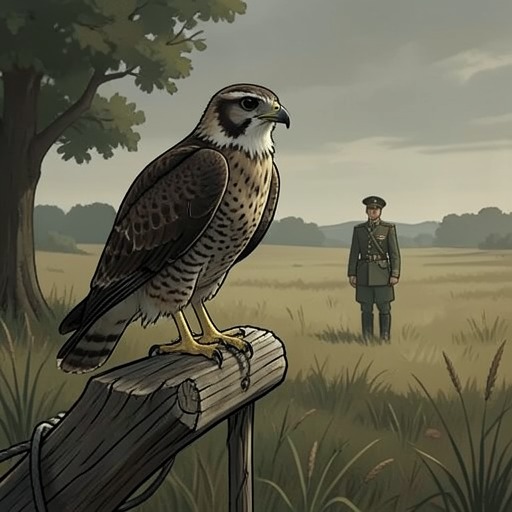
The phrase’s construction places two figures side by side without making them identical. The hawk and the helmeted airman both occupy the air and look down; the comparison offers a perspective from above, apparently removed from ordinary human life. Macdonald describes that prospect as height and power, a vantage from which death may descend. The pairing is therefore charged from the outset: it joins a bird’s hunting vision to the machinery and human purpose of aerial warfare, while leaving open whether their shared altitude can mean anything like shared safety.
Commanding height and the reality of war
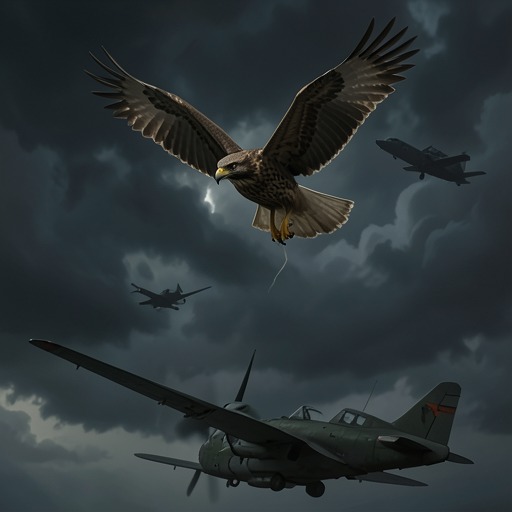
The bomber turns the poem’s elevated viewpoint into a material scene. It is painted deep USAAF wartime green, and as it banks overhead Macdonald sees its bomb bay and gun turret. The aircraft’s immense presence contrasts with Mabel’s response: she gives it one indifferent glance and continues eating. While woodpigeons scatter from the oaks, pheasants call, and rabbits bolt for their holes, the hawk remains at her meal. The contrast makes the bird’s attention distinct from the human observer’s astonishment and fear; the plane is momentous to Macdonald, but it does not interrupt Mabel’s immediate activity.
The passage then supplies the historical human cost concealed by the view from above. Macdonald imagines American airmen stationed there seventy years earlier, sleeping on cots in rain and fog and preparing before dawn to fly toward Germany. Their cockpits are described as iceboxes; heated suits fail, and oxygen hoses fur with crystalline ice. At altitude, airmen must bend and crush the hoses between their fingers to breathe. The flights take them through cloud and toward skies thick with exploding shells, where they release their cargo. One in four does not complete a tour of duty. The commanding perspective named by the poem cannot make these conditions safe, or render the consequences of the flights abstract.
The passage refuses to separate what happened to the airmen from what they did. Macdonald calls both terrible, then rejects the notion that war can be considered just air. This judgment breaks the apparent spell of elevation: from above, the world might look ordered into plots and vectors, but the view belongs to people exposed to danger and involved in inflicting it. The expression holds both sides of that fact together, rather than allowing altitude to stand as a simple symbol of freedom or power.
The hawk’s eye and the wish to withdraw
After the bomber disappears, Mabel finishes the rabbit, rubs pale fur onto the glove, and looks up at the empty sky. The small, precise actions return the scene to the hawk, while the remembered poem prompts Macdonald to search for its next lines: “The clouds rift suddenly – look there”. The words turn looking into an act of attention. Macdonald looks where the line directs, and the passage shifts from the aircraft’s immense spectacle to the pull of the hawk herself.
That pull is also a desire. Macdonald recognizes an old longing to possess the hawk’s eye: to live a safe and solitary life, watch from above, and keep the world below at a distance. The imagined observer would be invulnerable, detached, and complete. In this context, the poem’s elevated view is not only an analogy between hawk and airman; it becomes a tempting model for escaping human vulnerability. The passage does not present that escape as achieved. Macdonald’s eyes fill with water, and the thought of safety ends in the recognition that she is not safe.
Mabel’s actual presence complicates the fantasy of possessing her perspective. The hawk is on Macdonald’s fist, a thirty-ounce predator whose world is shaped by trajectories toward the deaths of living creatures. She is neither a disembodied viewpoint nor merely an emblem of detachment: she eats, cleans her beak, settles her feathers, and attends to the sky. The human wish to adopt her vision meets the particular life of the bird, which continues on its own terms rather than becoming a refuge from human feeling.
Inherited ways of looking
The passage carries the aerial image into the childhood of Helen Macdonald’s father, who grew up during World War II. For the first four years of his life, bombers passed overhead in formations, marked at night by searchlights and by day by trails of contrail. From below, aircraft could mean danger or defence, and recognizing which was which mattered to life. The poem’s elevated viewpoint is thus set against a child’s position beneath the machines: the airman looks down, while the child must identify what is crossing the sky.
That uncertainty gives plane-spotting its childhood urgency. Macdonald’s father made Airfix models, spent pocket money on Aeroplane Spotter, and learned to distinguish aircraft by the position of their engines, the shape and position of their tails, and their engine notes and fuselages. When older, he cycled to Farnborough, Northolt, and Blackbushe with a Box Brownie camera, a notebook, and a pencil, waiting by perimeter fences. The habits of identifying, classifying, and recording offered a way to learn and command the details of aircraft whose meaning could be perilously difficult to know from below.
Set beside that history, “As the hawk sees it, or the helmeted airman” links different acts of watching without collapsing their circumstances. A hawk’s predatory attention, an airman’s view from a bomber, a child’s anxious recognition of aircraft, and an adult’s patient recording all involve looking at the sky, but they do not carry the same power or risk. The recalled expression gains its significance from those contrasts: height can promise command, yet cannot abolish vulnerability, responsibility, or the human need to understand what is passing overhead.